What Is Group Housing in Greater Noida, and How Does It Differ from Builder Floors, Plots and Villas?
Published On
Nov 23, 2026
Group housing in Greater Noida generally means a planned residential development where multiple households live in separate apartments while sharing facilities such as entrances, internal roads, lifts, gardens and utility systems. A developer, authority or cooperative body may develop these homes.
Compared with builder floors, plots and villas, group housing usually offers more organized shared services, alongside maintenance charges and community rules. Choosing between them depends on the privacy, upkeep responsibilities, design freedom and documentation you prefer.
What Does Group Housing Mean?
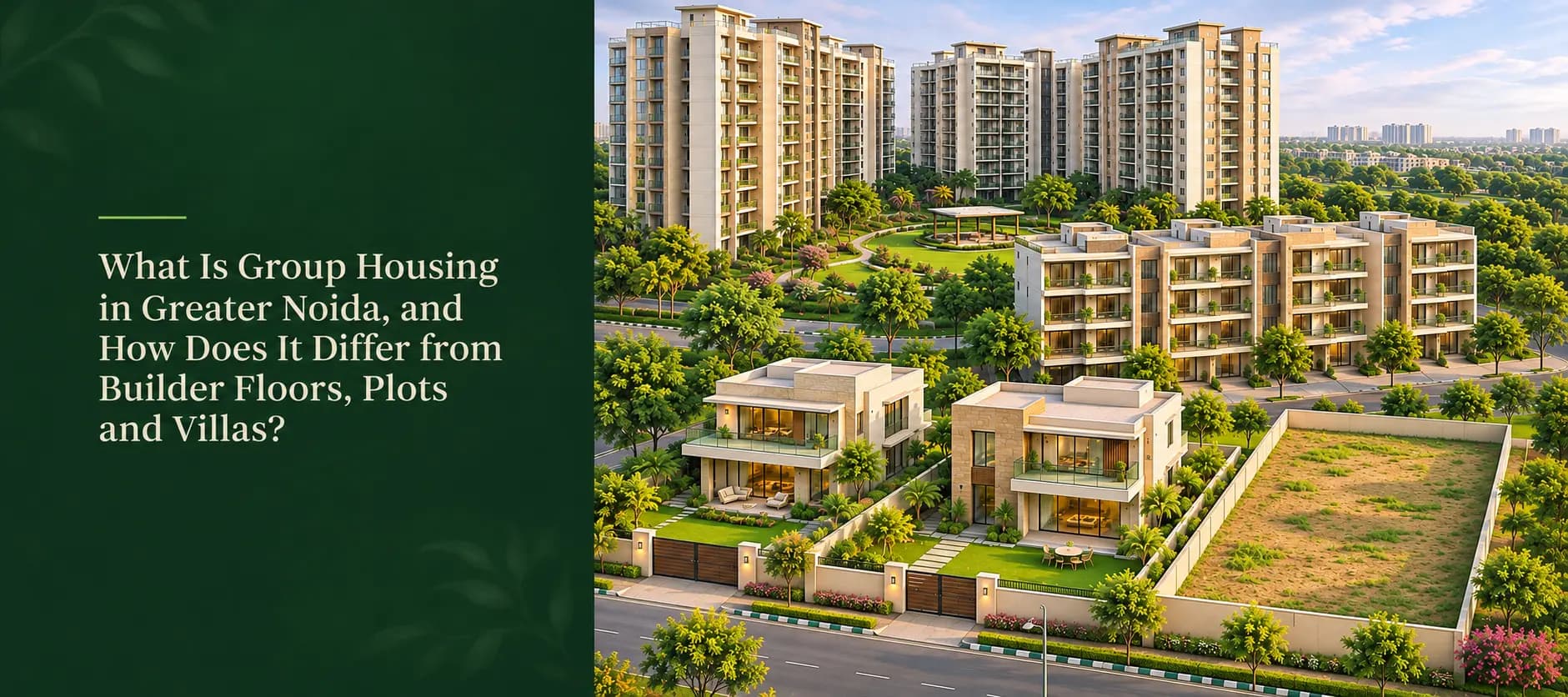
The simplest group housing meaning is multiple residential units developed together on a common site, with shared infrastructure. Each household occupies its own home, while designated spaces and services support the wider residential community.
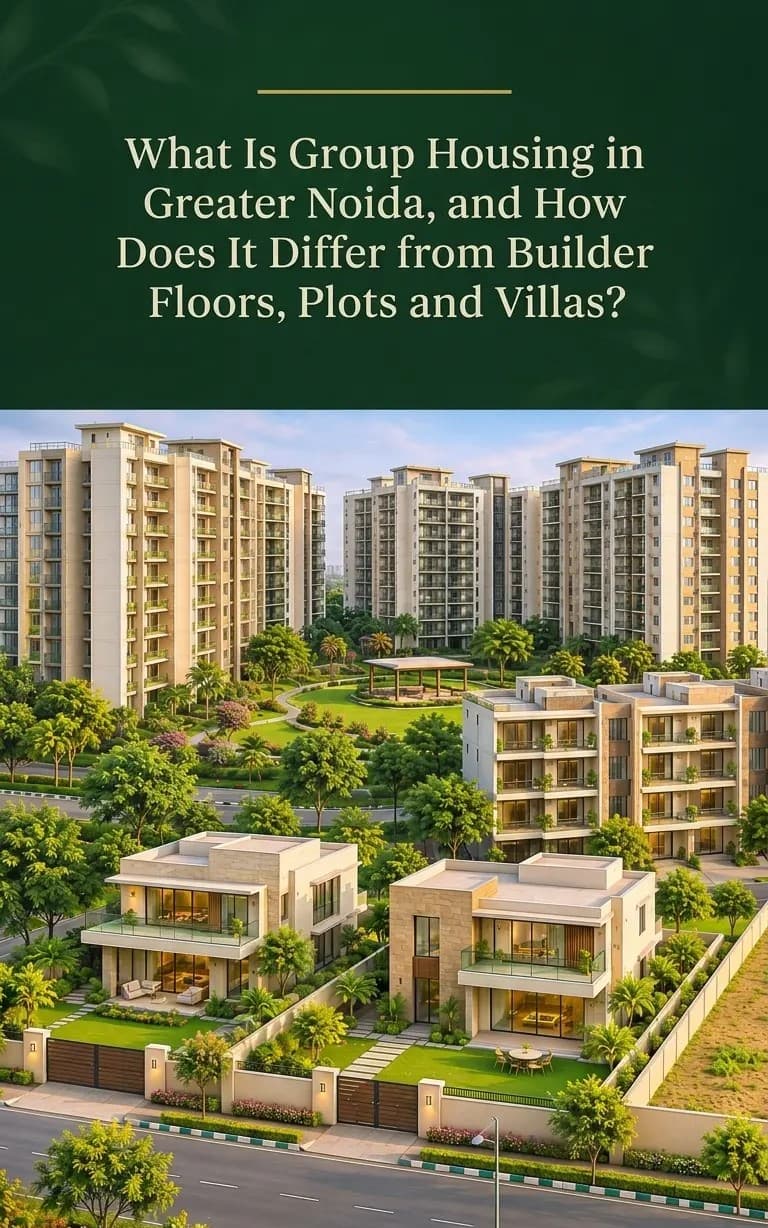
Think of an apartment development with several buildings, landscaped areas, pedestrian pathways and a common entrance. The apartments are individual homes; the development’s circulation spaces and infrastructure serve residents collectively.
Group housing is also a planning category. Greater Noida’s published building regulations address it separately and connect development requirements to approved plans and building controls. Therefore, a project’s sanctioned use matters more than its marketing description.
To see these ideas on a real plan, look at Northwind Sanctuary in Sector Pi, Greater Noida, a multi-tower residential development. Read its towers, open spaces and shared facilities against the definition above, and ask any developer the same questions.
Does Group Housing Always Mean High-Rise Towers?
No. Height alone does not explain the concept. Group housing can involve different building configurations, subject to applicable approvals.
Similarly, a swimming pool, clubhouse or luxury entrance is not what makes a development group housing. These are project-specific features. Buyers should check which facilities appear in approved plans and contractual commitments instead of assuming every apartment society provides them.
How Does Group Housing Work in Greater Noida?
The same words on an advertisement can sit on different approvals, so start with three questions. Which authority governs this exact location? Which sanctioned plan covers the tower you are looking at? Which RERA record applies to its phase? Write the answers in one note with the date you got them.
The portal steps are covered in our guide on how to verify RERA registration in Uttar Pradesh, so we do not repeat them here. If Sector Pi is on your list, our Sector Pi and Pari Chowk location page shows what the area is like for daily routines.
What Is a Group Housing Society?
In everyday property conversations, a group housing society usually means the residential community within an apartment development. People may use “society,” “apartment complex” and “residential project” interchangeably.
However, the physical development and the organization representing residents are different things. The buildings form the housing project; an owners’ association or another legally constituted body may represent owners and help administer shared matters.
A project described as a “society” is not automatically a cooperative housing society. Ask how the residents’ organization is constituted, what its responsibilities are and who currently manages maintenance.
Who Builds and Sells Group Housing?
Private developers commonly arrange development and sell apartments. Public development authorities and cooperative housing bodies can also undertake housing projects. Under RERA, the term “promoter” covers several such arrangements, including circumstances where the developer and seller are different parties.
Is the Developer the Same as the Contractor or Broker?
Not necessarily. The developer or promoter organizes the project, while a construction contractor may execute building work. A broker or channel partner helps market properties and connect buyers with sellers.
For a new apartment, identify the promoter named in the project registration and agreement. For resale, verify the current owner’s documents and authority to transfer the property.
A familiar brand name should never replace checking the legal entity involved.
How Does Group Housing Compare with Builder Floors, Plots and Villas?
The following comparison describes typical arrangements. Individual projects and ownership documents can differ.
Factor | Group housing | Builder floor | Residential plot | Villa |
What you buy | Apartment with associated shared rights | A floor or unit within a smaller building | Land rights defined by the title or lease | A house with specified land rights |
Privacy | Depends on layout, neighbors and shared access | Fewer households, but shared building elements | Depends on the eventual house design | Often greater separation, depending on layout |
Upkeep | Organized common maintenance plus internal repairs | Owners coordinate shared repairs | Owner manages construction and house upkeep | Owner maintains house; community charges may apply |
Design freedom | Mostly internal, subject to restrictions | Limited by structure and shared rights | Greater scope within building rules | Depends on approvals and community controls |
Approval focus | Project, building and relevant phase | Plot permission and legality of the specific unit | Title, permitted use, layout and building permission | Land rights, approved layout and house construction |
Best suited to | Households that value shared services and a managed community | Buyers who prefer a smaller building with fewer neighbors | Buyers ready to manage design, permissions and construction | Buyers who want a house-style home and accept any community rules |
Ask first | Who runs maintenance, and how are charges set? | Who shares the staircase, water and roof arrangements? | What can I build here, and how long will it take? | What does the community charge cover, and what can I change? |
How Is Group Housing Different from Builder Floors?
A builder floor usually refers to a separately sold dwelling occupying a floor, or part of a floor, in a relatively small residential building.
Group housing generally provides a larger framework of shared services. A builder-floor property may have fewer neighbors and simpler common areas, but owners still need arrangements for staircase cleaning, water pumps, lifts and structural repairs.
Do Builder Floors Always Offer More Privacy?
Fewer households can mean less activity around the entrance. However, privacy also depends on shared staircases, overlooking windows, wall construction and terrace access.
A well-planned apartment with fewer homes per landing may feel more private than a closely packed builder floor. Visit the actual property and examine the layout.
Also, do not assume a floor is independently saleable simply because it is advertised separately. Verify the sanctioned configuration and transfer rights.
How Is Group Housing Different from Buying a Plot?
With an apartment, you purchase a home within a development whose building design and common infrastructure are largely predetermined. With a plot, you generally take greater responsibility for creating the home.
That means appointing professionals, obtaining applicable permissions, coordinating construction and managing costs. A plot offers flexibility, but building freedom remains subject to permitted use, setbacks, height and other applicable controls.
Does a Plot Eliminate Maintenance Charges?
Not always. A plot within a managed development may attract charges for common roads, security or landscaping.
Even without community charges, the eventual house requires spending on waterproofing, exterior repairs, drainage and equipment replacement. Compare total ownership costs, including your time, rather than monthly society charges alone.
How Is Group Housing Different from a Villa?
A villa generally offers a house-like arrangement, often with a separate entrance and private outdoor space. Group-housing apartments typically share more circulation and building infrastructure.
However, “villa” is also a marketing term. It does not independently establish freehold ownership, unrestricted alterations or complete separation from neighbors.
Some villas share walls. Others sit within gated communities with common facilities, maintenance charges and architectural restrictions. Check the documents defining the house, land and shared rights.
How Do Privacy and Upkeep Affect Daily Living?
The practical difference is how much you want to manage personally and how comfortable you are sharing facilities.
Group housing can simplify everyday coordination through organized housekeeping, security and maintenance teams. In return, residents contribute to common expenditure and follow community procedures.
What Should You Check Beyond Amenities?
Ask about lift availability, homes per landing, visitor access, parking circulation and the distance between buildings. Look at bedroom windows and balconies for direct overlooking.
For maintenance, request the charging basis, included services, additional usage fees and arrangements for major repairs. A low introductory charge may not represent future operating costs.
Builder floors and independent homes also need repair reserves, even when nobody issues a formal monthly maintenance bill.
Which Approvals Should Buyers Check in Greater Noida?
Start by identifying the authority responsible for the exact location. A broad location label in an advertisement is insufficient.
Review land ownership or lease documents, permitted residential use, sanctioned plans and the seller’s rights. UP RERA’s project-registration documentation includes land-related disclosures and approval information, making it a useful cross-check.
Does RERA Registration Replace Building Approval?
No. RERA registration and local building permissions perform different functions. Verify registration where applicable, but also inspect the relevant approvals. Registration exemptions exist; the housing label alone does not determine eligibility.
Use the official UP RERA portal to check the registered project and promoter. Match the phase and location with your proposed purchase.
What Should You Check Before Moving In?
Verify the applicable completion and occupancy documentation for the relevant building or phase. A completion certificate concerns conformity with sanctioned plans; an occupancy certificate permits occupation under applicable local requirements. A possession offer should not be treated as a substitute.
Do All Group Housing Projects Feel the Same?
No. Two group housing projects can differ widely in tower count, homes per floor, open space and traffic movement. The label describes the format, not the experience. Northwind Sanctuary in Sector Pi-1 is planned as a low-density, multi-tower development; our article on what low-density living means in a Greater Noida high-rise shows how to judge that from a plan. Apply the same test to every project you shortlist, ours included.
Which Housing Format Should You Choose?
• You want others to run security, lifts and landscaping: group housing fits, with shared charges and community rules.
• You want few neighbors and a simple building: look at builder floors, and ask who maintains the common areas.
• You want to design your own house and can manage a build: a plot suits you, with permissions, cost and time on your side.
• You want separation and a house-style layout: consider a villa, after reading the documents on land, shared walls and community rules.
• You are unsure: pick your top three from privacy, upkeep time, budget and design freedom, then score each format against them.
Choose group housing if shared services and community facilities suit your routine. Consider builder floors for a smaller residential setting, plots for greater involvement in design and construction, or villas for a more independent arrangement.
Before shortlisting, compare privacy, usable space, annual upkeep and verified approvals. Explore our Greater Noida home-buying guides, then use the same checklist to visit properties.
Compare formats before you visit. Our guides on carpet, built-up and super area, verifying RERA registration and buying a luxury home in Greater Noida use the same checklist, so you can apply it to every property you see.
Comparing group housing homes in Greater Noida? Bring your shortlist and we will go through area basis, shared costs and approvals with you at Northwind Sanctuary. Book a site visit or talk to our team.
What Are the Frequently Asked Questions About Group Housing?
Q.1 Is Group Housing the Same as a Gated Community?
No. Group housing describes a residential development arrangement. A gated community describes controlled access and can contain apartments, villas or plots. A gate does not establish a property’s legal classification or approval status.
Q2. Is Group Housing Only for Luxury Apartments?
No. Group housing can serve different budgets and household needs. Luxury features, premium finishes and extensive amenities are separate from the basic housing format.
Q3. What Common Facilities Can a Group Housing Society Have?
Facilities may include lifts, internal roads, gardens, security systems and shared utility infrastructure. Some developments also provide pools, clubhouses or sports areas. Availability and access rights depend on the specific project.
Q4. Can Builder Floors and Villas Also Fall Under RERA?
Yes, depending on the development and applicable statutory requirements. RERA is not limited to high-rise apartments; the Act also covers qualifying plots and other real estate developments. Check the project’s circumstances and any claimed exemption.
Q5. Are Maintenance Charges Always Higher in Group Housing?
No universal rule applies. Costs depend on services, staffing, equipment, amenities and the number of contributing households. Independent homes may have fewer shared charges but leave individual owners responsible for substantial repair bills.
Q6. How Can I Check a Group Housing Project in Greater Noida?
Identify the exact project, promoter, location and phase. Check available UP RERA records, then compare them with land documents, sanctioned plans and the agreement. For a completed home, verify the relevant completion and occupancy documentation as well.
Q7. Can I renovate a group housing apartment?
Interior changes are usually possible within limits, but structure, façade, balcony enclosures and shared services are normally controlled. Read the sale agreement and the community's rules first, and get written permission where required.
Q8. Who decides the rules and charges in a group housing society?
The sale agreement and the community's governing documents set the starting rules. After handover, the residents' body generally takes part in decisions. Ask who manages the society now, how charges are worked out and how residents approve changes.
Q9. Do I own the land under a group housing apartment?
Usually you hold a share of the land and common areas together with your apartment, not a separate plot. The exact rights are written in the agreement, so ask for them in plain terms and compare them with the registered documents.
Q10. Is group housing suitable for families with children or older members?
It can be, if the project has what your family uses every day: lifts and step-free routes, safe internal roads, visible security and nearby daily needs. Check them in person at busy hours instead of relying on the brochure.
Q11. Is group housing a good choice for a first home?
It can be if you value predictable shared services and can budget for regular charges. Compare the full monthly outgo with what other formats would cost, and use our EMI calculator to see the loan part.